
By Dr. Heba Anis
What’s the difference? Your guide to face cleanser types
Between supporters and opponents of long, multi-step routines, there’s a middle ground. In my view, it depends on how much care your skin needs — intensive, medium, or light — and on the type of treatment products you use. So I try to arrive at the most suitable routine steps for each case.
I’ll start, God willing, by distinguishing and defining the different types of skincare products — beginning in the order of the routine steps themselves.
What’s the difference?
First, let me note that a product can have more than one quality — it might be a cleanser and an exfoliator, or nourishing — so it’s perfectly normal to find it mentioned in more than one category.
Cleansing
Daily morning cleansing
It depends on your skin type and the treatments you applied before bed. Lukewarm water is preferred — not hot, not cold. Dry and normal skin: lukewarm water only. Oily and combination skin: preferably a morning-specific cleanser, or a cleanser with very low pH (pH is the acidity measure — and facial skin is naturally mildly acidic, so the cleanser must preserve that balance).
Deep nighttime cleansing
The deep nighttime cleansing phase removes impurities, makeup residue, dust, and more — using a cleanser suited to your skin, age, and condition.
Weekly cleansing
Weekly cleansing is usually deep, and depends on each skin’s needs. It can take the form of an exfoliation, a mask, or both. Skin suffering from blackheads and pores does best with a steam session and a cleansing mask. Dry, normal, or even oily skin can use a scrub, an exfoliator, or a nourishing mask.
There’s also targeted cleansing — I’m not sure what to call it — but it’s a dedicated session (a facial), weekly or monthly, and it changes — you can do it each time according to your skin’s condition and needs, or for variety. For example: detox — acid peeling — nourishment with caviar, gold, or another therapeutic ingredient.
Each of these types is very important for the skin and the routine, depending on each skin’s needs — but they must enter your care according to the product’s nature and your skin’s needs: a daily cleanser — a weekly exfoliator/cleanser — a weekly or monthly facial session.
Face cleanser types and the differences
Note that you can use more than one cleanser type one after another — I’ll explain that in detail, God willing.
First: Soap
Most soaps have a pH of about 9 or 10 — while skin pH is about 4.7. That means soap changes the skin’s acidity — it disturbs its balance — exposing it to:
- bacterial growth, and therefore breakouts
- extreme drying of the skin’s oils, causing a condition called seborrhoea — a rebound reaction where the skin increases oil production, clogging the pores even more
This applies to harsh soaps. Oil-stripping soaps — and especially those with oily skin love them very much, and unfortunately may use them more than twice a day because they’re thrilled by the oil removal. In reality, this type of soap is better used on the body — and if it’s made for the face and says so, it should be used at most 3 times a week. There are soaps made of natural ingredients that moisturize or nourish the skin — what matters in them is the pH level. Keep it in mind.
Second: Cleanser
A cleanser’s pH varies by type, but it’s generally lower than soap. It comes in types — apart from the specialized ones for each skin and condition — but I’m talking about the basic types:
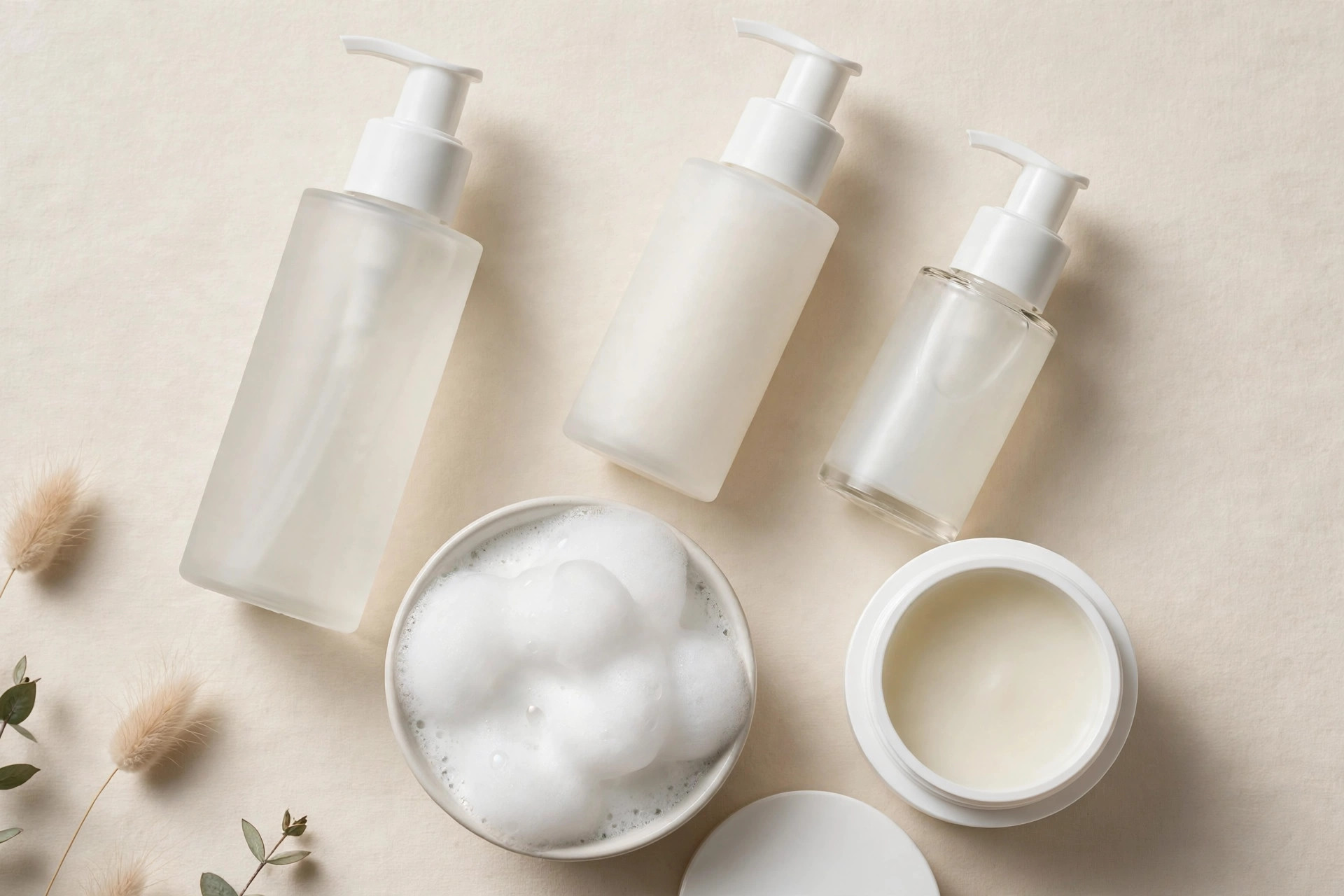
- Foaming cleanser / Face wash: there’s bubbly foam and creamy foam. The difference: bubbly foam makes strong lather with bubbles, while the creamy one turns more cream-like when you massage it in. The difference is almost negligible — not a big deal. It needs thorough rinsing, ideally once and at most twice a day. It removes impurities, dust, and pollution, cleans the skin well, and is highly effective at cleaning pores and the impurities in them, thanks to the foam’s nature.
- Creamy or milky cleanser (Cleansing lotion / Cleansing milk): this type has no foam at all — it’s like a cream or lotion you massage into your skin for about a minute, then wipe off with a cotton pad or a facial tissue — and needs no rinsing. It’s enough to wipe it with a face towel or facial pad. This type doesn’t replace a foaming cleanser for most skin types, but it’s ideal for dry and sensitive skin, and helpful for tired skin exposed all day to environmental pollutants and makeup. It’s best used before the foaming cleanser — a useful step in the routine, especially for dry and very sensitive skin.
- Gel cleanser (Cleansing gel): suits all skin types — moisturizing without adding oils to the skin — a gentle cleanser. Preferred in winter for oily skin, but also suitable for everyone in summer — and best used in the morning, because it’s gentle and moderate without stressing the skin.
- Oil cleanser (Cleansing oil): this type is effective at removing makeup effortlessly — but it’s not a standalone cleanser. It should be followed by a foaming cleanser step. It’s very suitable for very dry skin, especially for makeup wearers — and it’s enough for their cleansing.
- Balm cleanser (Cleansing balm): its texture is like a regular balm. This type is preferred for very dry and mature skin, because it cleans while giving the skin moisture and softness.
- Water cleanser (Cleansing water): this type suits very oily skin best, and needs no rinsing — just wipe with a cotton pad or tissue. Some people with oily skin may prefer this type since it has no oily, creamy, or foamy feel — while others won’t like it.
Types with cleansing properties — and other properties too
- Peeling gel: used 3 times a week for deep cleansing and exfoliation — and it replaces the weekly scrub, of course. When you apply it, you don’t clean your face with your daily cleanser first — it’s enough on its own.
- Massage cream: a thick, dense cream texture. This is a cream for massaging the skin that also cleanses it deeply — used only 3 times a week — like the Korean tomato mask. I deliberately gave an example, because many people mistakenly think it’s an instant brightening mask for daily use — and unfortunately skin problems happen. It — and any massage cream — is at most 3 times a week. Its goal is purifying the skin of impurities, getting rid of toxins, and stimulating blood circulation — and of course it has its own application method and specific time duration. It’s not just ordinary spreading.
- Powder wash: this is a powder — you add water and massage your skin, and it turns into foam. I consider it another form of the foaming cleanser.
- Cleansing tissue: this comes as paper wipes containing a cleansing substance — watery or lotion-based — used to remove creams or masks, remove makeup, or wipe off sunscreen.
There are cleansers that combine more than one type — for example, an oil that turns into foam, a powder that turns into foam, or a gel. And of course, multi-property cleansers are more expensive. Some cleansers contain oxygen so they make more bubbles. Some contain powder granules for deep cleansing. And some are ready-made cream foam — no hand-massaging needed. It’s ready to cleanse.
In the end — whatever the cleanser’s form or type — choose according to your skin type and its needs, and the rest of your routine. Variety is good, so your skin stays balanced.
With love and care.
Leave a Reply